
What's Rheology? The Science of Flow, From Our Blood to Mountains
Everything is fluid, In God’s and nature’s timescale, even mountains
Rheology is the science of flow and it was the topic of my PhD research. The science of rheology deals with the fact that all materials flow in a viscoelastic fashion, meaning somewhere between Viscous (flowing, releasing energy like liquids) and Elastic (Holding, storing energy like solids). The degree of elasticity and viscosity will depend on the relative time scales of stress and the material’s molecular relaxations and stress release. For example, when cold, molecules tend to resist flowing past each other so materials will act more elastic than viscous at low temperatures. Or when it comes to certain rubbery elastomers, long polymer chains entangle and resist flowing past each other. They stretch but resist flowing (shearing) too much. That is why tires in cars resist losing their shape when in friction with the road. As a result, they tend to store energy and not dissipate it as (too much) heat or through flowing.
True education is an orphan today because it’s not profitable. I spend hours to separate good science from bad, noise from signal. Please sign up to support this reader-supported publication, a wiser alternative to corporate-sponsored publications.
To characterize the relative viscosity and elasticity of a material, the ratio of material’s molecular relaxation time to the time scale of observation is called the “Deborah Number,” inspired by a verse in the Bible, stating “The mountains flowed before the Lord” in a song by the prophet Deborah in the Book of Judges. Nature is patient so everything is fluid, in nature's timescale, even mountains.

Some Non-Newtonian fluids (such as corn starch gels), like humans, act more solid under fast stress but yield and flow (act viscous) when we are gentle (slow and patient) and our time scale is long:
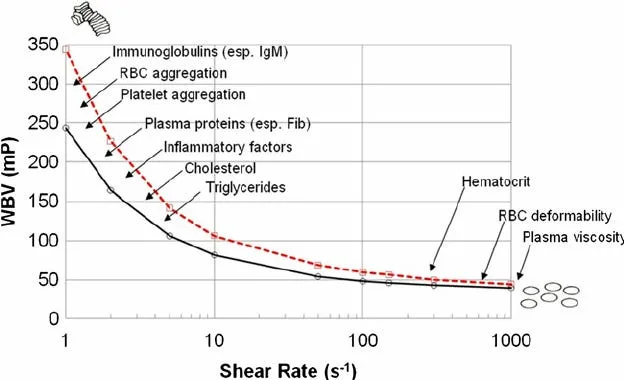
Blood is also non-Newtonian which means its viscosity changes with how fast we shear it. For example, shear rates are lower in veins and higher in smaller arteries so blood acts more viscous in veins and less viscous in small arteries. The blood viscosity also increases with antibodies, sickle cells, thrombosis (blood clots), etc. Anabolic steroids (like testosterone) are also linked to an increase in blood viscosity due to erythrocytosis (excess red blood cells and hemoglobin). This may explain the association between anabolic steroid usage and hypertension (high blood pressure), coagulation (thrombosis and plaque build up) disorders, and cardiovascular disease (CVD) primarily myocardial infarction, fatal arrhythmias, and cardiomyopathy.
The high incidence rate of severe COVID in some fitness gurus may also be linked to the effect of testosterone on blood viscosity.
A particular type of flow is laminar or in layers (not turbulent). A particular type of laminar flow is called Stokes flow (shown in the video), in which the orderly layers of fluid don't intermix so they can even be separated later when the flow is slowly reversed. Examples of Stokes flow in nature are swimming of microorganisms and sperm, and flow of paints and polymers, where viscosity is high, speed and density are low.
This post was my gift to you. Without sharing these with others, we cannot extend our network of independent critical thinkers.
In my just-released book (currently ranked number 1 in Amazon’s Modern Philosophy category), I share the 3 main laws of conservation in nature, and what they teach us about our mind and body. You can read more about my book in my last blog “A User Manual for Balancing the Human Brain and Body.”
Testosterone is also generally immunosuppressive