
Vance, Mamdani, Eyeliners: Benefits and Risks
A few months ago, the Chinese released a video making fun of Vice President JD Vance’s eyeliners after he advocated for imposing tariffs on Chinese imports:
We are not sure if JD Vance uses eyeliners but historically, many famous men have used eyeliner as a signature of their persona, style or perhaps for health or cosmetic benefits. The list includes Charlie Chaplin, David Bowie, Mick Jagger, Elvis Presley, Johnny Depp and Prince.
Recently, some bloggers have poked fun at Zohran Mamdani, New York city’s new mayor, for wearing eyeliners! Mamdani’s wife is also known for her distinctive winged black eyeliner.

Are there health benefits and risks to eyeliners? Let’s explore the history and science of eyeliners in simple terms:
History and Functions of Natural Eye liners:
“Natural” eyeliners have historically been made by using the organic natural soot from burning plants, date seeds, charcoals, nuts like almonds and hazelnuts, or animal fats, horns or bones. A typical natural formulation includes ground Galena rock (see below), burnt almond (organic, not sprayed), Animal fat or olive oil. By darkening eyelids, eyeliners were believed to reduce intensity and glare of reflected sunlight reaching into the eyes. The dark (smoky) substance would perhaps act as a natural electron and photon absorber/transducer and protect our eyes from damaging radiation such as UV and blue lights (digital devices, etc.).
Science today is complex, sponsored and politicized. Guided by his conscience and not politics or profits, Ray Armat, Ph.D. is an unsponsored polymath, former NASA grantee and an independent farmer, dedicated to share useful uncensored simplified science. Encourage him by subscribing (free or by donation).
In Ancient Persia and Egypt, kohl (sormeh or surma in Persian), was a natural eyeliners made from antimony stone or galena (lead sulfide), and used for cosmetic and healthy reasons. Egypt’s 18th Dynasty female Pharaoh Hatshepsut would grind charred frankincense into kohl eyeliner. Because kohl contains lead sulfide and may cause lead poisoning, some countries like US have banned its import in recent years. This is an excerpt from a Saudi paper about kohl which documented high concentrations of lead in kohl samples, reflected in high levels of lead in the blood of regular kohl users.
The use of ‘kohl’ (also called ‘surma’) as eyeliner is a popular practice in the Middle East, Asia and Africa. Traditionally, fine kohl powder is applied to the conjunctive surface of the eyelids in the same way that mascara is applied to the outer surface. The use of kohl for medical and cosmetic purposes can be traced back over many centuries. Medicinally, it is used to stop bleeding and after circumcision for hygienic measures. All ethnic communities and people belonging to different religions use kohl in these areas of the world. However, kohl from Saudi Arabia is considered as a precious gift among Muslims during the pilgrimage season. Its use is not only socially acceptable; people encourage its use and correlate its use to prophetic sayings. Some scientific reports in the recent past have suggested the potential adverse effects of kohl on health, such as its possible role in lead poisoning, which makes it a health risk and worth investigating.
But other researchers have documented the benefits of kohl, if used in very small and dilute doses, by showing that thin films of lead sulfide are effective in absorption and lowering transmittance in the UV light band.
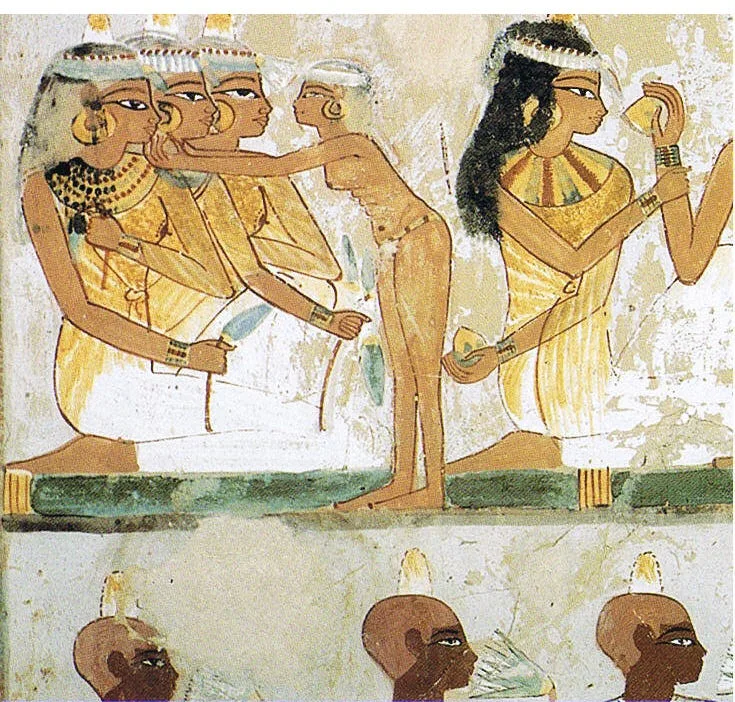
Image: Ancient Egyptian women and men wearing kohl eye liner, from the tomb of Nakht in Thebes (15th century BC) By Unknown author - Matthias Seidel, Abdel Ghaffar Shedid: Das Grab des Nacht. Kunst und Geschichte eines Beamtengrabes der 18. Dynastie in Theben-West, von Zabern, Mainz 1991 ISBN 3805313322, Public Domain, https://commons.wikimedia.org/w/index.php?curid=2416403
French researchers have also reported that the particular heavy eye makeup that ancient Egyptians wore containing lead compounds would elicit production of nitric oxide (NO), which in turn can trigger an enhancement of the immune response in the eye and vasodilation (blood flow) for improved eye health. Here is the abstract of the paper:
Lead-based compounds were used during antiquity as both pigments and medicines in the formulation of makeup materials. Chemical analysis of cosmetics samples found in Egyptians tombs and the reconstitution of ancient recipes as reported by Greco-Roman authors have shown that two non-natural lead chlorides (laurionite Pb(OH)Cl and phosgenite Pb2Cl2CO3) were purposely synthesized and were used as fine powders in makeup and eye lotions. According to ancient Egyptian manuscripts, these were essential remedies for treating eye illness and skin ailments. This conclusion seems amazing because today we focus only on the well-recognized toxicity of lead salts. Here, using ultramicroelectrodes, we obtain new insights into the biochemical interactions between lead (II) ions and cells, which support the ancient medical use of sparingly soluble lead compounds. Submicromolar concentrations of Pb2+ ions are shown to be sufficient for eliciting specific oxidative stress responses of keratinocytes. These consist essentially of an overproduction of nitrogen monoxide (NO°). Owing to the biological role of NO° in stimulating nonspecific immunological defenses, one may argue that these lead compounds were deliberately manufactured and used in ancient Egyptian formulations to prevent and treat eye illnesses by promoting the action of immune cells.
In Indian culture, kājal (a type of kohl, which traditionally uses natural ingredients like medicated soot, sometimes with added herbs and plants like jujube or camphor for health benefits) is worn by women around their eyes for health reasons and to ward off bad omens and the evil eye (nazar).
Risks of Modern Synthetic Eyeliners
As compared to natural eyeliners (Kohl or Surma), synthetic cosmetic eyeliners may not contain lead compounds (although many do) but contain other harmful ingredients like synthetic fragrances and dyes such as Coal Tar Dyes (FD&C Blue No. 1, FD&C Red No. 6, instead of burnt nuts in natural formula) which can all be neurological disruptors, paraffin or petroleum-based waxes (instead of animal fat or vegetable oils), alcohol and chemical preservatives (such as triclosan or parabens which are suspected endocrine disruptors), BHA and BHT (preservatives and suspected carcinogens), fillers and emollients, such as talc and polybutene, Formaldehyde (antibacterial but also a carcinogen), aluminum (neurotoxic).
Conclusions
To protect our vision against excessive or harmful light, our eyes rely on good blood flow, retinal and Vitamin A precursors found in natural orange-colored vegetables such as carrots and squash. The historic use of natural eyeliners based on burnt nuts probably made sense in arid sunny lands like Egypt and Saudi Arabia, that did not have many sources of animal or vegetable-based Vitamin A (vegetables, milk cream, egg yolks, etc.) usually available in areas with green pastures and less intense sunlight. The use of lead- or antimony-based stones, whether for their antibacterial, light/UV absorptive or nitric-oxide stimulating (vasodilatory, anti inflammation) properties may have also been justified in natural, diluted or low-concentration forms.
Today’s availability of blue-light blocking orange-colored glasses, vegetables rich in Vitamin A, antibacterial and nitric-oxide stimulating herbs, and our knowledge of techniques to promote eye health (see my article Natural Ways to Regain Eyesight and Eye Health for simple ways to protect our eyes such as herb tinctures), would make the use of eyeliners, especially the synthetic or concentrated lead-based types, unnecessary. As indicated in my earlier article, a simple Surma (kajal) made at home from burnt (organic, non sprayed) nuts (almond, walnuts, etc.) is a lower cost and better alternative to commercial potentially harmful products.
So if I were JD Vance or Zohran Mamdani, or any of the many women (or men) who use eyeliners for their health benefits, I would first read insightful non-sponsored articles on Simplescience.Substack.com😊 Please share my articles with others, so we can extend our network of critical/free thinkers and truth seeking souls.
Related: Natural Ways to Regain Eyesight and Eye Health
Li-Yun C, Wen H, Jian-Feng H and Jian-Peng W (2008). “Influence of deposition voltage on properties of lead sulfide thin film”. American Ceramic Society Bulletin, 87(6): 9101–9104