
The Story of a Man whom Einstein Considered a Genius, and his Argument with a Judge
An opening to the analytical mind whom Einstein admired
In my last blog “Why Did Einstein Remove his Hat in Rainy Weather?” I shared some rare and interesting stories about the way Einstein thought, lived and made decisions.
The blog about Einstein is available if you sign up to this reader-supported publication, a wiser alternative to corporate-supported publications.
Today, I will share another short story about Einstein’s good friend, Kurt Gödel, a logician, mathematician, and philosopher, that will provide another opening to the minds of analytical people and critical thinkers. Gödel and Einstein developed a strong friendship, and were known to take long walks together to and from the Institute for Advanced Study in Princeton. The nature of their conversations was a mystery to the other Institute members. Economist Oskar Morgenstern recounts that toward the end of his life Einstein confided that his "own work no longer meant much, that he came to the Institute merely ... to have the privilege of walking home with Gödel." Here is the story:
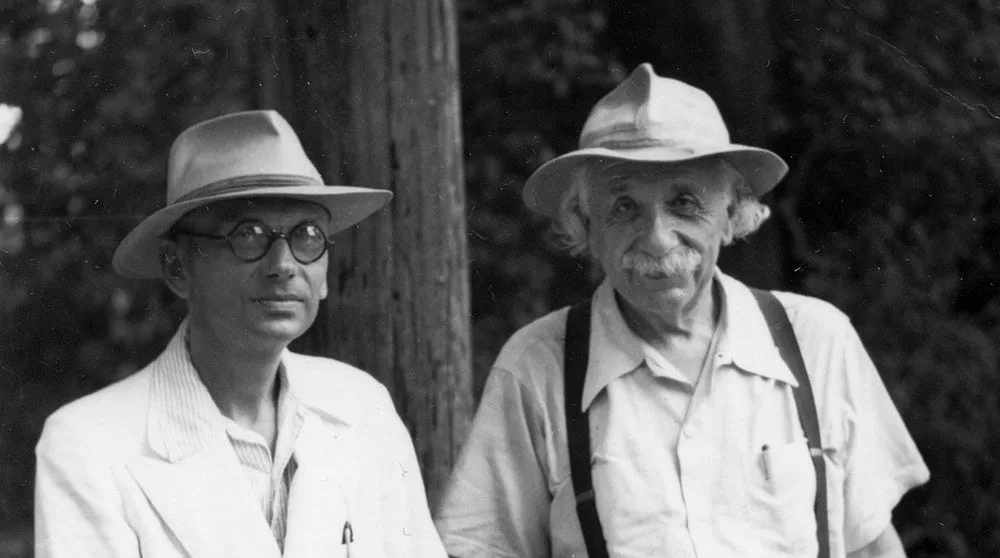
Gödel’s intense logic sometimes overwhelmed his common sense. For example, when he decided to become a U.S. citizen in 1947, he took his preparation for the exam very seriously and studied the U.S. Constitution carefully and critically (as might be expected by the man who formulated “the incompleteness theory”).
On December 5, 1947, Einstein and another friend accompanied Gödel to his U.S. citizenship exam, where they acted as witnesses. Gödel had confided in them that he had discovered an inconsistency and logical flaw in the U.S. Constitution that could allow the U.S. to become a dictatorship; this has since been dubbed Gödel's Loophole. Einstein was concerned that his friend's unpredictable behavior might jeopardize his application if Godel argued with the Judge. The judge turned out to be Phillip Forman, who knew Einstein and had administered the oath at Einstein's own citizenship hearing. Everything went smoothly until Forman happened to ask Gödel if he thought a dictatorship like the Nazi regime could happen in the U.S. Gödel then started to explain his discovery of a flaw in the U.S. Constitution. The judge understood what was going on, cut Gödel off, and moved the hearing on to other questions and a routine conclusion.
This post was my gift to you. Without sharing these with others, we cannot extend our network of independent critical thinkers.
Gödel is of the brightest logicians in human history, yet he believed in ghosts, rebirth and time travel, and thought that mathematical abstractions were every bit as real as tables and chairs. He also believed firmly in an afterlife, saying, "Of course this supposes that there are many relationships which today's science and received wisdom haven't any inkling of. But I am convinced of this [the afterlife], independently of any theology. It is possible today to perceive, by pure reasoning" that it "is entirely consistent with known facts… If the world is rationally constructed and has meaning, then there must be such a thing [as an afterlife]."
Following the assassination of his close friend Moritz Schlick in Germany, Gödel developed an obsessive fear of being poisoned, and would eat only food prepared by his wife Adele. When she was hospitalized beginning in late 1977, Gödel refused to eat. He weighed 65 pounds when he died of malnutrition and starvation in Princeton Hospital on January 14, 1978.