
Sultan's Harem, Lady Montague, Milkmaids: The Fascinating History of Vaccination
How Jenner's Original Vaccine Differed from Today's Technology
There is a lot of controversy today about the risks and benefits of vaccines but the controversy is not new. As I explained in a previous blog:
It probably started in late 19th Century with a bitter disagreement between two prominent scientists about the origin of disease-causing (pathogenic) microorganisms. Antoine Béchamp, the father of the microzymian theory, attributed pathogenic organisms to imbalances and dysfunctions in host and environmental conditions, whereas Louis Pasteur, the father of germ theory, blamed “exogenous” bacteria and microorganisms for disease.
If you are not aware of the riveting story of vaccination involving countries like England, Turkey (Ottoman empire), Persia (Iran), India and China, you may find the following excerpt from a “the history of smallpox and vaccination” interesting. At the end of the article, I will share a surprising historic fact about the original intent behind early vaccines, which contrasts with today’s vaccination paradigm and goals.
Smallpox affected all levels of society. In the 18th century in Europe, 400,000 people died annually of smallpox, and one third of the survivors went blind. The symptoms of smallpox, or the “speckled monster” as it was known in 18th-century England, appeared suddenly and the sequelae were devastating. The case-fatality rate varied from 20% to 60% and left most survivors with disfiguring scars. The case-fatality rate in infants was even higher, approaching 80% in London and 98% in Berlin during the late 1800s. True education is an orphan today because it’s not profitable. I spend hours to separate good science from bad, noise from signal. By subscribing (free or paid) you allow me to expand our network of critical thinkers as an alternative to corporate-sponsored publications. The word variola was commonly used for smallpox and had been introduced by Bishop Marius of Avenches (near Lausanne, Switzerland) in ad 570. It is derived from the Latin word varius, meaning “stained,” or from varus, meaning “mark on the skin.” The term small pockes (pocke meaning sac) was first used in England at the end of the 15th century to distinguish the disease from syphilis, which was then known as the great pockes… It was common knowledge that survivors of smallpox became immune to the disease. As early as 430 bc, survivors of smallpox were called upon to nurse the afflicted… However, the most successful way of combating smallpox before the discovery of vaccination was inoculation. The word is derived from the Latin inoculare, meaning “to graft.” Inoculation referred to the subcutaneous instillation of smallpox virus into nonimmune individuals. The inoculator usually used a lancet wet with fresh matter taken from a ripe pustule of some person who suffered from smallpox. The material was then subcutaneously introduced on the arms or legs of the nonimmune person. The terms inoculation and variolation were often used interchangeably… Inoculation, hereafter referred to as variolation, was likely practiced in Africa, India, and China long before the 18th century, when it was introduced to Europe. In 1670, Circassian traders introduced variolation to the Turkish “Ottoman” Empire. Women from the Caucasus, who were in great demand in the Turkish sultan's harem in Istanbul because of their legendary beauty, were inoculated as children in parts of their bodies where scars would not be seen… Variolation came to Europe at the beginning of the 18th century with the arrival of travelers from Istanbul. .. however, they did not change the ways of the conservative English physicians. It was the continued advocacy of the English aristocrat Lady Mary Wortley Montague that was responsible for the introduction of variolation in England. In 1715, Lady Montague suffered from an episode of smallpox, which severely disfigured her beautiful face. Her 20-year-old brother died of the illness 18 months later. In 1717, Lady Montague's husband, Edward Wortley Montague, was appointed ambassador to the Sublime Porte. A few weeks after their arrival in Istanbul, Lady Montague wrote to her friend about the method of variolation used at the Ottoman court. Lady Montague was so determined to prevent the ravages of smallpox that she ordered the embassy surgeon, Charles Maitland, to inoculate her 5-year-old son. The inoculation procedure was performed in March 1718. Upon their return to London in April 1721, Lady Montague had Charles Maitland inoculate her 4-year-old daughter in the presence of physicians of the royal court.
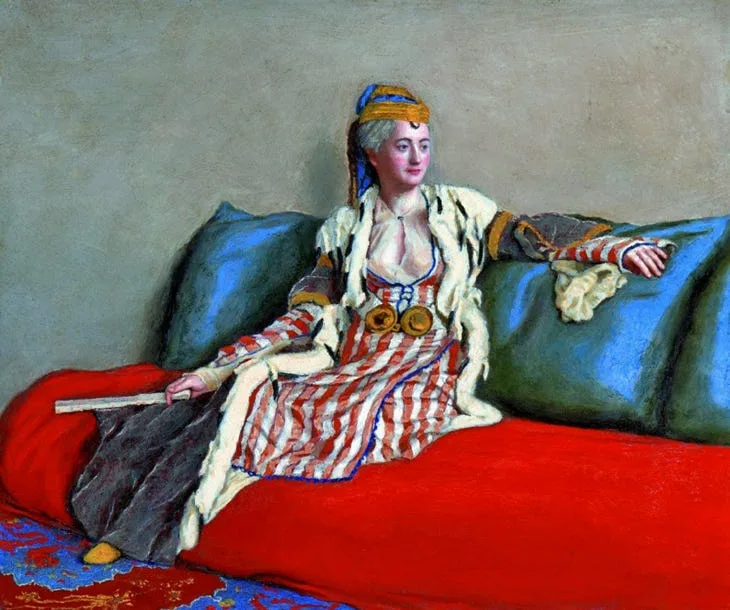
Lady Mary who sported elaborate Turkish dresses, boasted that she and her husband were the first Christians from Europe to journey across the Hungarian plains in 1716, where he was to be ambassador to the Sultan’s court.
Although it was Lady Montagu who introduced the technique practiced in the Islamic world into Europe, the earliest use of natural inoculation could be traced to Persians of the 11th century. Ottoman manuscripts in Istanbul University Library depict the renowned father of early medicine, the Persian physician, Ibn Sina (known in the West as Avicenna), treating patients with smallpox in early 11th century.
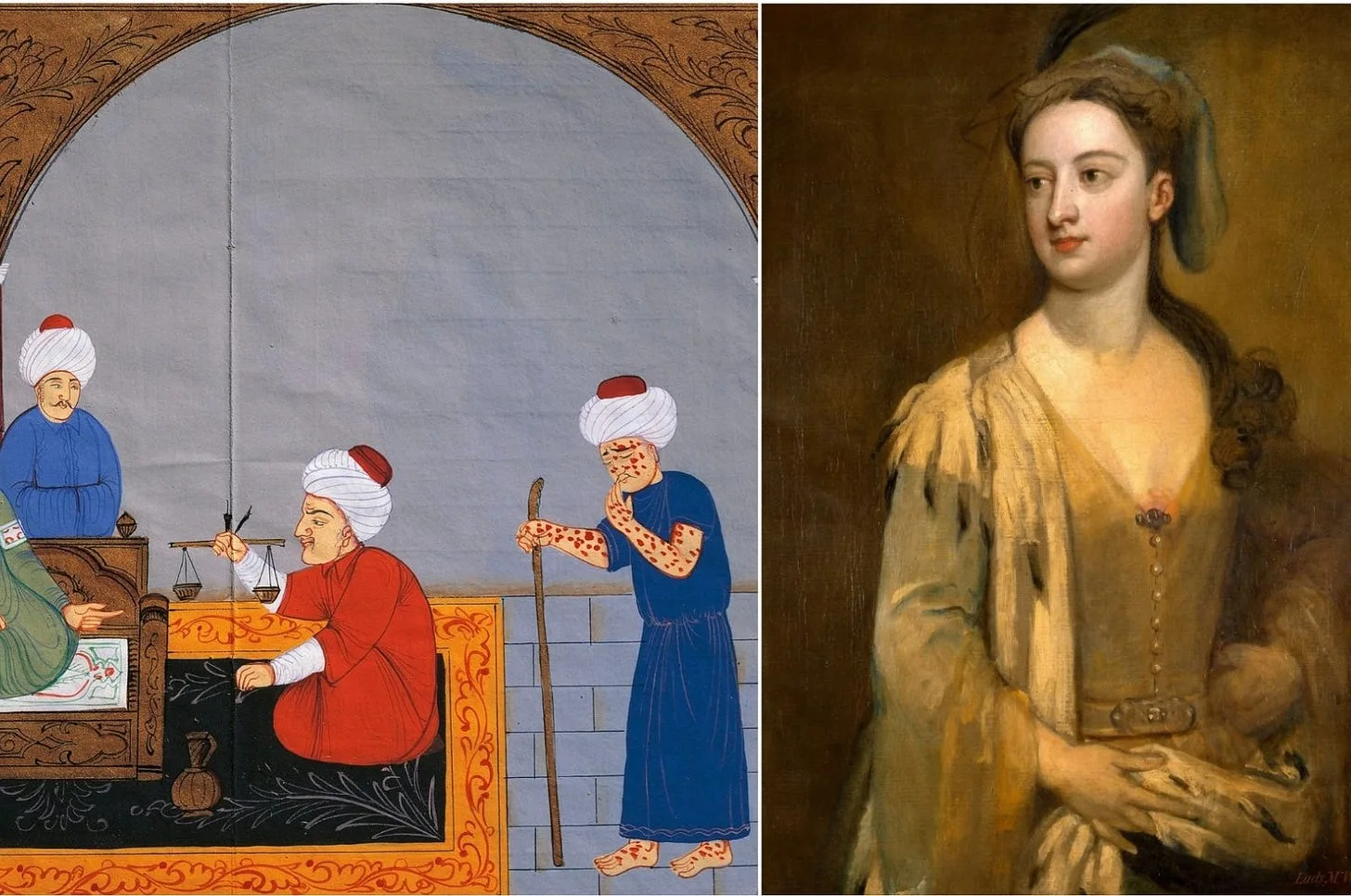
Two other places in particular have been suggested as the early birthplaces of inoculation: India and China. In China, written accounts of the practice of ‘insufflation’ (blowing smallpox material into the nose) date to the mid-1500s. In India, 18th century accounts of the practice of inoculation (using a needle) trace it back to Bengal, where it had apparently been used for many hundreds of years.
Edward Jenner’s Contribution
Edward Jenner, the father of modern-day vaccination, was born in 1749. At age 13, while apprenticing to a country surgeon and apothecary in Sodbury, near Bristol, Jenner heard a dairymaid say, “I shall never have smallpox for I have had cowpox. I shall never have an ugly pockmarked face.” What Jenner heard was a common belief among laypeople (non-scientists) that dairymaids were in some way protected from smallpox.
Later in life, Jenner as a scientist concluded that cowpox not only protected against smallpox but also could be transmitted from one person to another as a deliberate mechanism of protection. In May 1796, Edward Jenner found a young dairymaid, Sarah Nelms, who had fresh cowpox lesions on her hands and arms (Figure (Figure33). On May 14, 1796, using matter from Nelms' lesions, he inoculated an 8-year-old boy, James Phipps. Subsequently, the boy developed mild fever and discomfort in the axillae. Nine days after the procedure he felt cold and had lost his appetite, but on the next day he was much better. In July 1796, Jenner inoculated the boy again, this time with matter from a fresh smallpox lesion. No disease developed, and Jenner concluded that protection was complete. The Latin word for cow is vacca, and cowpox is vaccinia; Jenner decided to call this new procedure vaccination.
Despite controversies and chicanery, the use of vaccination spread rapidly in England, and by the year 1800, it had also reached most European countries.
These blogs are my gifts to my subscribers. Without sharing them with others, we cannot extend our network of critical thinkers.
Contrary to modern-day view of vaccination which focuses on “artificial” active immunization, Jenner’s original approach was to make humans, who had lost tolerance to cow pox after moving to densely populated industrially polluted cities, more “tolerant” to natural microbes and not to protect people “against” germs (using artificial lab-synthesized injections). In fact, Jenner defines disease as a deviation from a “natural” state. In 1798, Jenner opened his seminal work on vaccination against smallpox: An Inquiry into the Causes and Effects of the Variolæ Vaccinæ with the following words:
The deviation of Man from the state in which he was originally placed by nature seems to have proved to him a prolific source of Diseases.
Although he received worldwide recognition and many honors, Jenner made no attempt to enrich himself through his discovery. He actually devoted so much time to the cause of vaccination that his private practice and his personal affairs suffered severely. Tragically, Jenner lost his son, sister and wife to tuberculosis in later years.
*************************
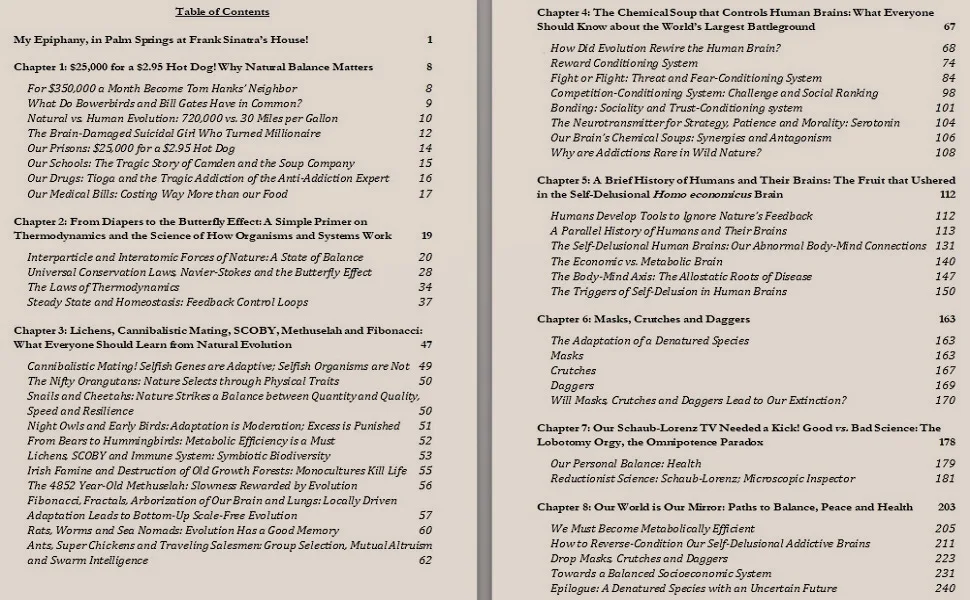
In Chapter 7 of my new book (as shown in the table of contents below) I share a detailed explanation of the modern reductionist approach to science with its benefits and drawbacks:
Interestingly, Lady Monatgu’s son, a well-read fan of Turkish, Persian and Arabic books, a rebel and an outlaw, later fathered a Massoud Fortunatus Montagu from an Egyptian Muslim woman.