Home-Made Anti-Viral Nasal Spray and Irrigation Solutions
Simple, Inexpensive and Effective for Early Mediation Against Viral Replication
As I write this article, I am competing for people’s attention with a popular model/singer, trending on social media because of her racy swimsuit workout pictures in subzero temperatures. Thanks to her name, looks, the theme and major sponsors, she reaches millions. Good for her.
My blog here, which took me four hours to prepare, may reach a few thousand people (between my Substack and twitter account). In such an attention-based economy, I highly doubt if I ever recover the opportunity cost of my time (as an independent scientist blogger researching for myself and people and not for sponsors or corporations). What drives independent writers like me is sharing what we find useful for ourselves with smart independent readers who in return spread the word, buy our books or become a paid subscriber. I guess bloggers and podcasters are no different than the raunchy musicians asking for attention, except we sponsor education and information, which are becoming orphans when fun and controversy grab everyone’s attention!
Viruses take days to colonize (replicate) our Nasopharynx (space between our nose and throat). Early reduction of the viral load may be helpful if you suspect being exposed to viral loads in public spaces. Several research studies show viral load reduction by proper daily nasal irrigation with certain inexpensive solutions listed below:
We hire our own mechanic to fix our cars but for our body/mind, we trust news and science sponsored by corporations. Science is complex. As a trained scientist, I spend hours to separate good science from bad, noise from signal. Please support this reader-supported publication as a subscriber (free or paying).
- Isotonic (0.9%) saline (For example, 2 gram or half a teaspoon of salt in one cup or 240 cc of water) or hypertonic saline (1-2 teaspoons of salt added to one cup of water). You can also buy these solutions as nasal sprays.
- Povidone-iodine (0.1%): For example, 2.5 mL of 10% povidone iodine (like Betadine) diluted in one cup (around 240 cc) isotonic saline. Povidone-iodine could activate thyroid so it should be diluted.
- Sodium bicarbonate (baking soda) at 0.1%: For example, 2.5 mL diluted in one cup (around 240 cc) of isotonic saline.
- Iota-Carrageenan (I-C) is a sulfate polysaccharide synthesized by red algae, with demonstrated antiviral activity and clinical efficacy as nasal spray in the treatment of common cold. In vitro, I-C inhibits SARS-CoV-2 infection in cell culture. The incidence of COVID-19 was lower by 80% (vs. placebo) in subjects receiving the nasal spray with I-C.
- This one includes medications you cannot make at home! Steroid solutions such as budesonide or mometasone, are commonly added to saline irrigations for control of inflammatory mediators in chronic rhinosinusitis.
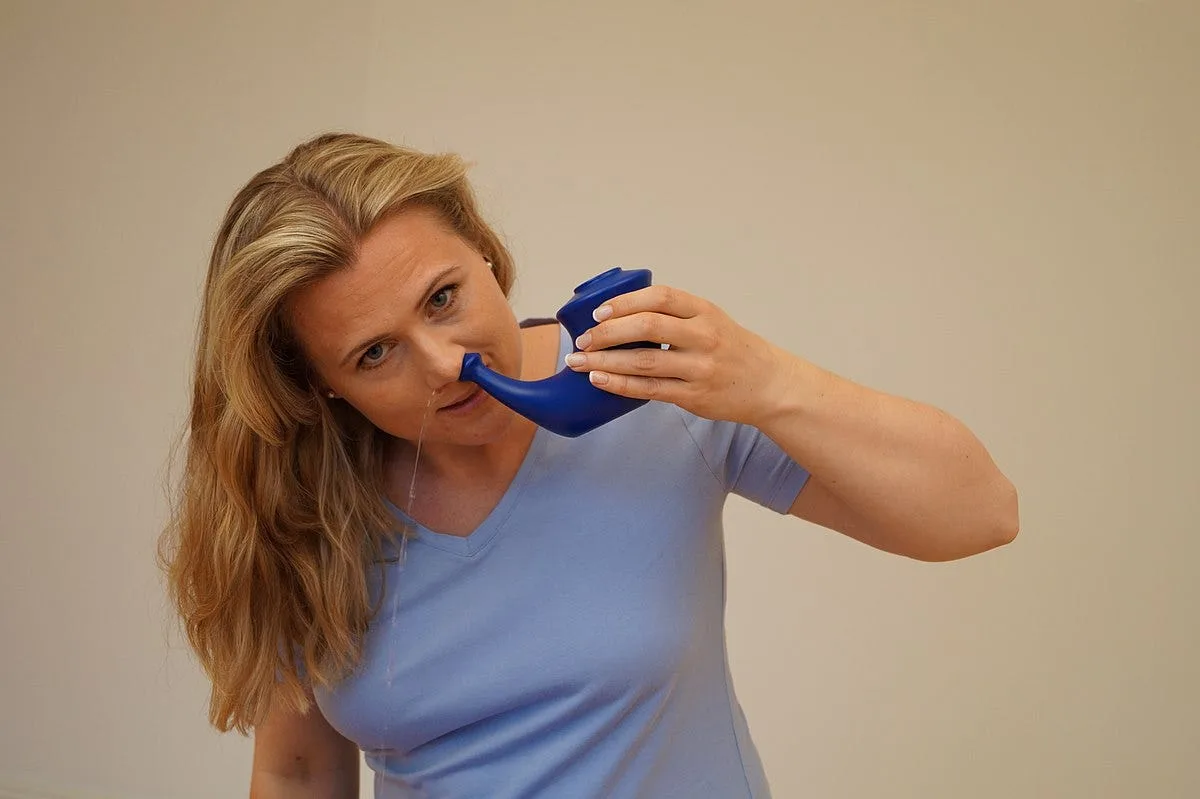
- Daily Jalneti (rinsing using Neti pot, as pictured above, or other irrigation devices) with saline or lukewarm sterilized water has reportedly helped medical staff at a major Indian hospital fight viral infection.
It is important to note that the rinse bottles and surrounding surfaces may become contaminated and serve as a source of infection so people should practice good hand hygiene and decontaminate the surrounding surfaces (sink, counters) and plastic rinse bottle to prevent subsequent infection.
Other ways to inactivate viral particles which may be unsafe, and therefore not tested on human subjects include use of diethyl ether, 75% ethanol, chlorine, UV light, or heat (56 °C for 30 minutes). There are also antibacterial solutions like xylitol that will reduce attachment of bacteria to epithelial cells.
It is also important to note that nasal irrigation as an early mediation against viral replication should not replace treatment or medical advice for anyone suspecting serious infection or disease.
Blogs like this are buried in our busy world. If you found this helpful, show that you care by sharing it with friends and family.