
Everyone Should Know these Little-Known Facts about Milk and Dairy Industry: Part I
Eye-Opening Education About Factors that Control the Quality of Milk and Dairy Products
What our food does to our body’s metabolic health depends on the “metabolic” history of that food. This is what we are observing in vegetables grown chemical-free (the old-fashioned way) on our farm, and what I reflect in my articles and recent book The Right Way to Eat.
Animal-based products are even more sensitive to processing and treatment of the animal. Most people think all milks are the same (except for fat content). That is not true. The following factors all play a role in the quality and metabolic signature (nutrition potential) of milk:
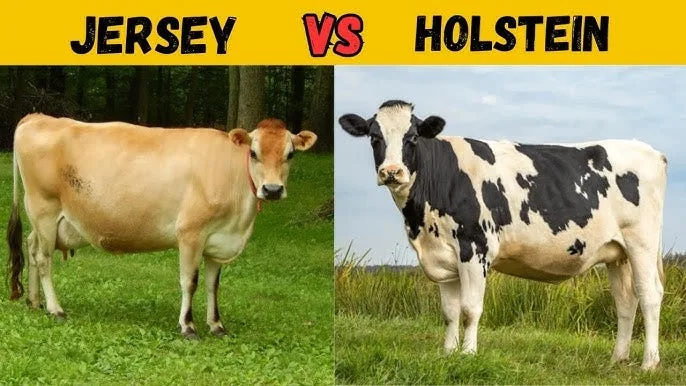
- Type/breed of cow: Jersey and Guernsey cows produce milk with fat content often averaging 5-6%. Brown Swiss cows are a close third, while Holstein-Friesians produce large volumes of milk with a lower fat percentage, around 3.5%. Many commercial dairy farms use the higher-yield Holstein cows that can produce on average 70 pounds (about 9 gallons) per day. We buy our raw creamy milk from a local farm with a pasture-raised (organic pasture) Jersey cow because Jersey cows usually produce cream with higher butterfat and vitamin A compared to Holsteins (the yield in image below is in Kilograms per day).
- Grazing and Feed Access: As compared to cows confined Pasture-raised cows foraging on grass often produce more nutritious milk as explained below about Vitamin A, etc. Since Vitamin A or its precursors are orange-colored, cream and butter from pasture-raised cows are more orange-yellow. As you can see later, some cow feed additives try to artificially create this yellow-orange color for cheaper milks from confined cows. Today, many commercial “natural” butter and cheese products, despite showing pastoral pictures of cows foraging on grass, are made from cream milked from “confined” or “fed” cows. These brands often add yellow-orange color additives to create the natural Vitamin A or Beta-carotene’s yellow-orange color. Next time you buy yellow-colored cheese or butter, don’t assume it’s a sign of high Vitamin A. Just read the ingredients label to find out about these color additives.
- Hormones: Several artificial hormones are used in (non-organic) dairy cows for artificial increase in milk production (such as recombinant bovine somatotropin rBST also called recombinant Bovine growth hormone rBGH) or reproduction control, such as gonadotropin-releasing hormone (GnRH), follicle-stimulating hormone (FSH), luteinizing hormone (LH), estradiol, testosterone, and progesterone (for increased meat production in beef) and prostaglandins (to force terminate pregnancies, or to artificially expedite estrus (heat) and new ovulation cycle and reduce the time from calving to the first insemination. Cows fed with hormones (injected or as feed additive) such as recombinant bovine somatotropin (rBST, for increasing milk production) and trenbolone acetate, melengestrol acetate (MGA), can be susceptible to cancer, endocrine disruptions, fertility and reproductive issues, stress, aggressiveness and swelling, udder infections that require more antibiotic treatment, which contributes to antibiotic resistance. We are what we eat! So there are also serious concerns about health effects on humans from milk and meat produced using hormones. For example, drinking milk or eating meat from rBGH-treated cows is known to increase blood levels of insulin-like growth factor (IGF-1) in humans, linked to growth of both regular and cancer cells in the body. Also, cows treated with rBGH tend to develop more udder infections (mastitis) and given more antibiotics compared to cows not given rBGH. This means hormone-treated cows will be more susceptible to infections, antibiotic resistance and gut/immune system issues. Also, a study conducted by Emory University found that bovine growth hormone levels were 20 times higher in conventional milk than in organic milk. Many countries like Canada prohibit artificial growth hormones.
- Pregnancy: In commercial dairy farms in the US, cows are usually kept pregnant nine months out of a year, often through AI (artificial insemination), which is not natural pregnancy by physical mating but via technicians injecting/depositing frozen semen from a genetically-selected bull directly into the cow’s uterus when she is in heat. In the US cows are usually milked (for human consumption) often ten months out of a year (including seven months during pregnancy and the three months after delivery before next cycle of pregnancy). In contrast, in some other countries pregnant cows are not milked after month three of pregnancy. For example, Mongolian pasture-raised cows are milked five 5.5 months a year (3 months in early pregnancy and 2.5 after freshening or delivery). The combined effect of artificial and frequent pregnancies and prolonged milking during pregnancy, can be stressful to the heifers and to the humans consuming the milk for the following reasons…More in the next article, Part II.My Humble Request 🙏:Most information today is sponsored by businesses or large donors. I do not accept sponsors and do not place my articles behind paywalls so every seeker and critical thinker, rich or poor, can benefit from what I share. This way, I am not beholden to any particular donors or sponsors and can speak my truth and follow my God-given conscience. To encourage and allow folks like me to continue sharing useful uncensored industry insight and unsponsored research for free, please subscribe, for a free, or if you can afford a donation, a paid subscription and please share these articles so we can extend our network of critical thinkers and truth seekers.Thank youSubscribe